
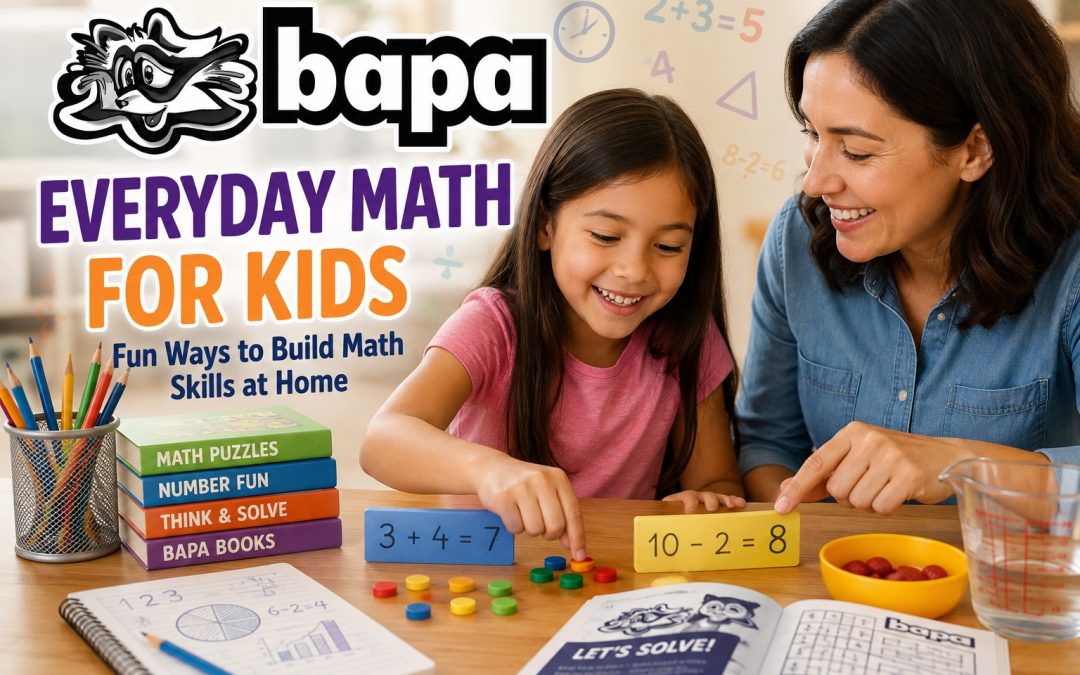
Children use math far more often than they may realize. From counting strawberries at breakfast to measuring ingredients for cookies, comparing prices at the store, or figuring out how many minutes are left before bedtime, numbers are part of everyday life.
For parents, that creates a wonderful opportunity. Helping children develop math skills doesn’t always require worksheets, flash cards, or formal lessons. Some of the most meaningful learning happens naturally through ordinary activities at home and out in the world.
At Bapa Books, we believe math becomes much less intimidating when children can see how numbers work in real life. Turning everyday moments into simple math activities can help kids strengthen their skills, improve problem-solving, and—perhaps most importantly—build confidence.
Turn Cooking into a Math Lesson
The kitchen may be one of the best math classrooms in the house.
Recipes introduce children to counting, measurement, fractions, time, temperature, and sequencing without making the activity feel like a lesson.
Depending on your child’s age, ask them to:
- Count the number of eggs needed for a recipe.
- Measure one cup of flour or half a cup of milk.
- Double or halve a simple recipe.
- Compare which measuring cup holds more or less.
- Calculate how long something needs to bake.
- Divide a pizza, sandwich, or batch of cookies into equal portions.
Older children can explore fractions and multiplication by adjusting serving sizes. Younger kids can simply count spoonfuls or compare quantities.
And there’s a pretty good reward at the end of this math lesson: you get to eat the homework.
Practice Math at the Grocery Store
A trip to the grocery store is packed with opportunities to practice everyday math.
Young children can count apples, oranges, cans, or other items as they go into the cart. Ask questions such as, “We need six bananas and already have four. How many more do we need?”
Older children can compare prices, estimate the total cost of several items, calculate change, or determine which package offers a better value.
You can even create a small challenge by giving your child a budget. For example, ask them to choose a snack for the family while staying under $10.
Suddenly, addition and subtraction have a purpose.
Use Money to Make Numbers Meaningful
Learning about money is one of the easiest ways to show children why math matters.
Start with real or play coins and bills. Younger children can identify different coins, count them, and group them by value.
As their skills improve, try creating a pretend store at home. Put prices on toys or household items and let your child become the shopper or cashier.
Ask questions like:
“If this costs $4 and you have $10, how much money will you have left?”
These simple games reinforce addition and subtraction while also introducing children to budgeting and financial decision-making.
Look for Math While Driving
Car rides offer another easy opportunity for quick math games.
Have younger children count red cars, trucks, traffic lights, or signs. Older kids can work with distance and time.
Try questions such as:
“We have 60 miles to go and we’ve already driven 20. How many miles are left?”
Or:
“If it takes us 30 minutes to get there and we leave at 2:15, about what time will we arrive?”
You can also use license plates to create addition, subtraction, or number-pattern challenges.
The beauty of these activities is that they require no supplies—and they can make a long drive considerably more interesting.
Bring Math Into Playtime
Children naturally encounter mathematical ideas while playing.
Building with blocks introduces shapes, size, balance, symmetry, and spatial reasoning. Board games often involve counting spaces, recognizing patterns, adding points, and making strategic decisions.
Even organizing toys can become a math activity.
Ask your child to sort objects by size, shape, type, or color. Then count each group and compare them.
“Which group has the most?”
“How many more blue blocks are there than red ones?”
“What happens if we divide these equally between two people?”
You’re practicing mathematical thinking without announcing, “Okay, now it’s time for math.”
That distinction can matter to a child who has already decided math is difficult or boring.
Explore Shapes and Patterns Everywhere
Math isn’t only about arithmetic.
Geometry, patterns, and spatial relationships are all around us.
Take a walk through your neighborhood and ask children to find circles, rectangles, triangles, and other shapes. Look at windows, road signs, buildings, playground equipment, flowers, tiles, and fences.
Patterns are everywhere, too.
Kids can identify repeating patterns in clothing, flooring, music, nature, and architecture—or create their own patterns using blocks, crayons, beads, or household objects.
Activities like these help children understand that mathematics is something they can observe and explore, not simply something printed on a worksheet.
Use Sports to Practice Math
If your child loves sports, use that enthusiasm.
Scores provide natural opportunities for addition and subtraction. Statistics can introduce averages, percentages, comparisons, and probability.
Ask:
“How many more points does our team need to tie?”
“If she made 7 out of 10 shots, how many did she miss?”
“How many runs would the team have if they scored two more?”
Children are often much more interested in solving a math problem when the numbers relate to something they already care about.
Let Kids Help with Household Projects
Everyday household tasks can introduce surprisingly sophisticated math concepts.
Measuring a room for a rug involves length and area. Hanging pictures requires measurement and spacing. Gardening can involve counting seeds, measuring distances, estimating soil, and tracking plant growth.
Even setting the table offers a simple counting exercise:
“We have five people eating dinner. How many plates, forks, and cups do we need?”
As children get older, the questions can become more challenging.
The goal isn’t to turn every chore into a pop quiz. Instead, occasionally draw attention to the math that is already there.
Ask Questions Instead of Giving Answers
One of the best ways to encourage mathematical thinking is surprisingly simple: give children enough time to think.
When a child encounters a problem, resist immediately supplying the answer.
Instead, try asking:
“How could we figure that out?”
“Is there another way to solve it?”
“Does that answer seem reasonable?”
“What do you notice?”
Questions encourage children to experiment with ideas and develop their own problem-solving strategies.
Getting an answer wrong can also be useful. Instead of treating mistakes as failures, help children examine how they arrived at the answer and try another approach.
That’s how mathematical confidence grows.
Make Math Practice Feel Like a Challenge, not a Chore
Everyday activities are wonderful for showing children why math matters, while puzzles and structured practice help strengthen the skills, they use to solve those real-world problems.
Bapa Books was created around that same idea of combining learning, creativity, puzzles, and fun. The Bapa Books math collection includes activities ranging from basic arithmetic practice to mathematical cryptograms and number-sense challenges designed to help young learners become more comfortable and confident with numbers.
The goal isn’t simply to complete more problems. It’s to help children become curious about how numbers work.
Building Math Confidence One Everyday Moment at a Time
You don’t need to recreate a classroom at home to help your child become better at math.
Cook together. Count things. Compare prices. Play games. Measure a room. Talk about time. Look for patterns. Ask questions.
When children repeatedly encounter math in comfortable, familiar situations, numbers begin to feel less abstract. They start recognizing math as a useful tool for understanding and navigating the world around them.
And once children begin saying, “Hey, I can figure this out,” something important has happened.
They aren’t simply practicing math anymore.
They’re becoming confident problem-solvers.
At Bapa Books, we believe learning should inspire curiosity, creativity, and fun. Explore Bapa’s growing collection of math books for kids designed to challenge young minds while helping children discover just how enjoyable numbers can be.
For more information, check out Bapa Books and Bapa’s Word Puzzle Books, Coloring Books for Kids, and Number Sense Books. Follow us on Facebook and X.
This content is for general reading purposes only and should not be considered as medical or professional advice