
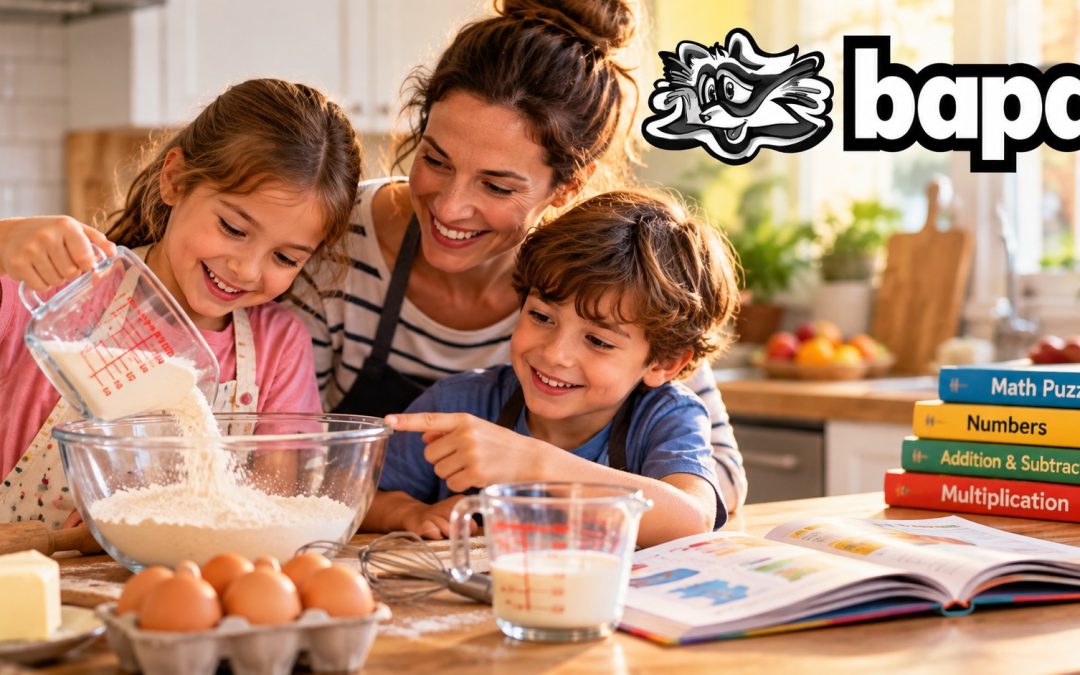
Math is an essential part of everyday life, but children don’t always recognize how often they use it outside the classroom. From measuring ingredients for a favorite cookie recipe to counting game pieces during family game night, opportunities to practice mathematical skills are everywhere. When parents weave math into familiar activities, children can build a stronger understanding of numbers while enjoying quality time with their families.
At Bapa Books, we believe learning should be engaging, creative, and enjoyable. By introducing mathematical concepts through cooking, baking, games, and other family activities, parents can help children strengthen their problem-solving abilities and build confidence without making learning feel like another homework assignment.
Turn Cooking into an Everyday Math Lesson
The kitchen is one of the most practical places to introduce children to mathematics. Preparing meals involves counting, measuring, estimating, and following sequences, making it an excellent environment for hands-on learning. Even simple activities, such as counting eggs or measuring cups of flour, can help younger children become more comfortable working with numbers.
For example, ask your child to count the number of ingredients needed for a recipe or determine how many tablespoons are required to make a particular dish. Older children can practice multiplication and division by doubling a recipe or adjusting the quantities to prepare fewer servings. If a recipe requires two cups of flour and you want to make twice as much, your child can calculate that you’ll need four cups.
Cooking also provides opportunities to introduce mathematical vocabulary. Discuss measurements such as cups, teaspoons, tablespoons, and ounces, and let children compare different quantities. These simple conversations help connect mathematical concepts to practical experiences that children can understand and remember.
Explore Fractions and Measurements Through Baking
Baking offers an especially enjoyable way to teach children about fractions, measurements, and proportions. Unlike some cooking activities, baking often requires carefully measured ingredients, allowing children to see why accuracy matters when following a recipe.
When making cookies, muffins, or cupcakes, ask your child to compare a full measuring cup with a half-cup or quarter-cup measure. Demonstrate how two half-cups equal one whole cup and how four quarter-cups create the same amount. Children can also practice adding fractions by combining different measurements to reach the quantity a recipe requires.
Older children can explore more challenging concepts by adjusting ingredient quantities. If a recipe requires three-quarters of a cup of sugar, ask how much would be needed to double the recipe. Working through these calculations with actual measuring cups makes fractions easier to visualize and understand.
Baking also builds time management and estimation skills. Children can calculate when cookies should be ready, compare baking times for different recipes, and estimate how many cookies a batch of dough will make. Always supervise children around hot ovens, sharp utensils, and other kitchen equipment.
Practice Addition and Subtraction During Family Game Night
Family game night provides an entertaining opportunity to reinforce basic math skills without relying on traditional worksheets. Board games, card games, and dice games naturally involve counting, addition, subtraction, and strategic thinking.
When playing a board game, younger children can count the spaces they need to move or add the numbers shown on two dice. Older children can calculate score differences, determine how many points they need to win, or practice mental arithmetic while tracking their progress.
Card games can also introduce number comparisons and basic operations. Ask children to add the values of two cards, subtract the smaller number from the larger one, or arrange cards in numerical order. These activities encourage children to think about numbers while enjoying friendly competition and family interaction.
The goal is to make mathematical thinking a natural part of the game, not interrupt the fun with constant questions. Allow children to work through problems at their own pace and celebrate their effort as well as their correct answers.
Use Grocery Shopping to Teach Money and Budgeting
A family trip to the grocery store can become a valuable lesson in addition, subtraction, multiplication, and money management. Give younger children a short shopping list and ask them to count the number of items needed. They can also compare quantities, identify prices, and estimate how much different products will cost.
Older children can practice budgeting by helping plan a meal within a specific spending limit. For example, provide a $20 budget and ask them to calculate the total cost of several ingredients. They can determine how much money remains after each purchase and compare different package sizes to identify the lower unit price.
These experiences introduce practical financial concepts while demonstrating how mathematics helps people make everyday decisions.
Make Math Part of Outdoor Family Activities
Mathematical learning doesn’t have to happen indoors. Gardening, neighborhood walks, and outdoor games provide opportunities to explore counting, measurement, geometry, and estimation.
While planting a garden, children can measure the distance between seeds, count the number of plants in each row, or calculate how many seedlings will fit in a particular space. During a neighborhood walk, ask them to identify geometric shapes in buildings, road signs, and playground equipment.
Families can also measure distances during outdoor games, compare scores, or estimate how long it will take to walk a particular route. These activities demonstrate that math is useful in many different situations and encourage children to recognize mathematical patterns in the world around them.
Encourage Mathematical Thinking Through Everyday Questions
One of the simplest ways to help children develop stronger math skills is to encourage curiosity and independent problem-solving. Rather than immediately providing an answer, ask questions that invite children to explore different approaches.
For example, when dividing a pizza among family members, ask how many slices each person will receive if everyone gets an equal share. When setting the dinner table, ask how many plates, forks, and glasses the entire family needs.
Encourage children to explain how they arrived at their answers and explore alternative solutions when appropriate. Mistakes can become valuable learning opportunities when children feel comfortable experimenting with numbers and trying again.
Build Math Confidence with Bapa Books
Everyday family activities offer meaningful opportunities to introduce mathematical concepts, while educational books and puzzles provide extra ways to practice and reinforce those skills.
Bapa Books offers a collection of engaging children’s math books designed to make learning numbers more enjoyable. From addition and subtraction activities to mathematical cryptograms, multiplication challenges, and number-sense exercises, these books encourage children to explore mathematics through puzzles and problem-solving activities.
Hands-on family experiences with engaging math books allow children to practice familiar concepts in different ways. For example, a child who learns fractions while baking cookies can apply that understanding when working through math exercises or solving puzzles.
Frequently Asked Questions about Teaching Math Through Cooking and other Family Activities
At what age can children start learning math through cooking?
Children can begin exploring simple mathematical concepts through cooking as early as preschool. Counting ingredients, comparing quantities, and identifying shapes are appropriate starting points. As children develop their math skills, you can introduce more advanced activities involving fractions, multiplication, and recipe adjustments.
How can parents make learning math more enjoyable?
Incorporating math into activities children already enjoy can make learning feel more natural. Cooking, baking, board games, shopping, and outdoor activities provide opportunities to practice mathematical skills without turning every experience into a formal lesson.
Can math activity books help children develop stronger skills?
Math activity books can provide structured opportunities to practice arithmetic, number recognition, and problem-solving. Combining educational books with hands-on experiences can help children apply mathematical concepts in both familiar and new situations.
Make Everyday Moments an Opportunity to Learn
Teaching children math doesn’t have to involve complicated lessons or hours of worksheets. Simple family activities can help children discover how numbers work while building confidence, creativity, and problem-solving skills. Whether you’re baking cookies, playing a board game, or planning a family meal, every shared experience offers an opportunity to make mathematics more meaningful.
Explore the collection of Children’s Math Books from Bapa Books and discover engaging educational activities designed to help young learners build their mathematical skills. Visit Bapa Books to explore additional children’s books, puzzles, and creative learning resources for the whole family.
Disclaimer: This article is intended for general informational and entertainment purposes only and should not be considered professional advice. Always consult a qualified professional regarding your specific needs or circumstances.