
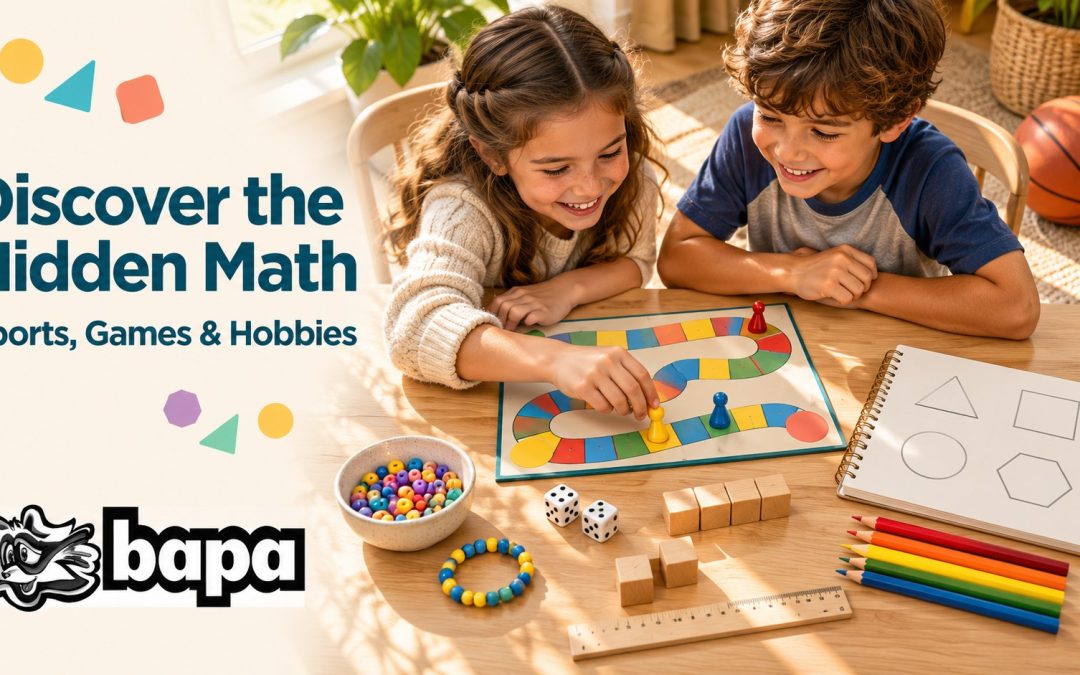
Math does not stay inside a classroom. It shows up when a child keeps score during a basketball game, plans a move on a game board, or measures materials for a craft project. These familiar activities give numbers a purpose, helping children explore mathematical ideas through things they already enjoy.
For parents looking for everyday math activities for kids, a favorite sport or hobby offers a natural starting point. Bapa Books celebrates that connection between curiosity, play, and learning through math books, puzzles, and activities that invite children to think beyond a worksheet.
Sports Make Numbers Meaningful
Keeping score provides opportunities to practice addition and subtraction without interrupting the fun. During a basketball game, ask how many points separate the teams or what combinations of two-point and three-point baskets could close the gap. If a team trails by seven points, children can explore several scoring possibilities rather than search for just one answer.
Sports also introduce fractions, percentages, and measurement. Making six out of ten practice shots represents six-tenths, or 60%. A runner who completes four laps of a 400-meter track travels 1,600 meters. These examples connect calculations to visible results, giving children something concrete to discuss and compare. Keep the challenge appropriate to their age: younger children might count baskets, while older learners calculate averages.
Board Games Bring Probability to the Table
Rolling dice creates an easy opening for conversations about chance. With one fair six-sided die, each number has the same probability of appearing. With two fair six-sided dice, however, the totals are not equally likely. Seven can occur through six ordered combinations, while two can occur only through a one and a one.
Children can investigate this themselves by recording totals over several rounds. Their results will not necessarily match the theoretical probabilities exactly, especially with a small number of rolls. That difference offers another useful lesson: probability describes likelihood, not a promise about what happens next. Games become opportunities to make predictions, collect information, and reconsider a strategy.
Puzzles Encourage Patterns and Logical Thinking
Puzzles invite children to notice relationships, test possibilities, and check whether an answer fits. A number pattern might ask what comes next, while a logic challenge requires keeping track of several conditions. The reasoning matters as much as the final response.
Bapa Books’ Mathematical Cryptogram Series combines arithmetic practice with word decoding. Addition, subtraction, or multiplication problems become part of uncovering a hidden message. This gives a calculation a second purpose: each answer helps the solver progress toward a larger discovery. Choosing a suitable difficulty helps keep the experience challenging without making it discouraging.
Creative Hobbies Use Geometry and Measurement
Art and crafts contain plenty of mathematical decisions. A repeating bead bracelet involves patterns; a symmetrical drawing involves reflection; a model built from a plan involves dimensions and scale. Even arranging shapes within a coloring design can become a conversation about triangles, circles, and how different forms fit together.
Try asking a child to create a bracelet using a repeating group of two blue beads and one yellow bead. Five complete groups require 15 beads altogether, including ten blue and five yellow. For a building activity, compare the planned length of a model with the available materials. These small projects make counting, grouping, and measuring part of creating something tangible.
Outdoor Interests Turn Observations into Data
Walking, hiking, and bicycling provide opportunities to record distances, compare times, and look for patterns. A family might track how far it walks each weekend or estimate how long a familiar route will take. Older children can explore average speed: traveling six miles in 30 minutes produces an average of 12 miles per hour.
A simple notebook can hold predictions and actual results. Rather than focusing on beating a previous time, discuss why results change. Rest stops, hills, and different routes all affect comparisons. This encourages children to think about what numbers represent instead of treating every calculation as an isolated exercise.
Frequently Asked Questions
How can I introduce math without making play feel like homework?
Ask one natural question and follow your child’s interest. Leave room to enjoy the activity without turning every moment into a lesson.
What if my child gives an incorrect answer?
Invite them to explain their thinking, then use objects, drawings, or another example to explore the calculation together.
Which activities work best for different ages?
Start with counting and simple patterns, then introduce measurement, fractions, percentages, and probability as children become ready.
Explore Bapa Books’ math books for kids for arithmetic cryptograms and number-sense practice. Discover its puzzle books for more ways to bring playful problem-solving into family time.
Disclaimer: This article is intended for general informational and entertainment purposes only and should not be considered professional advice. Always consult a qualified professional regarding your specific needs or circumstances.